Data Center Transparency And Accountability
The Data Center Conflict
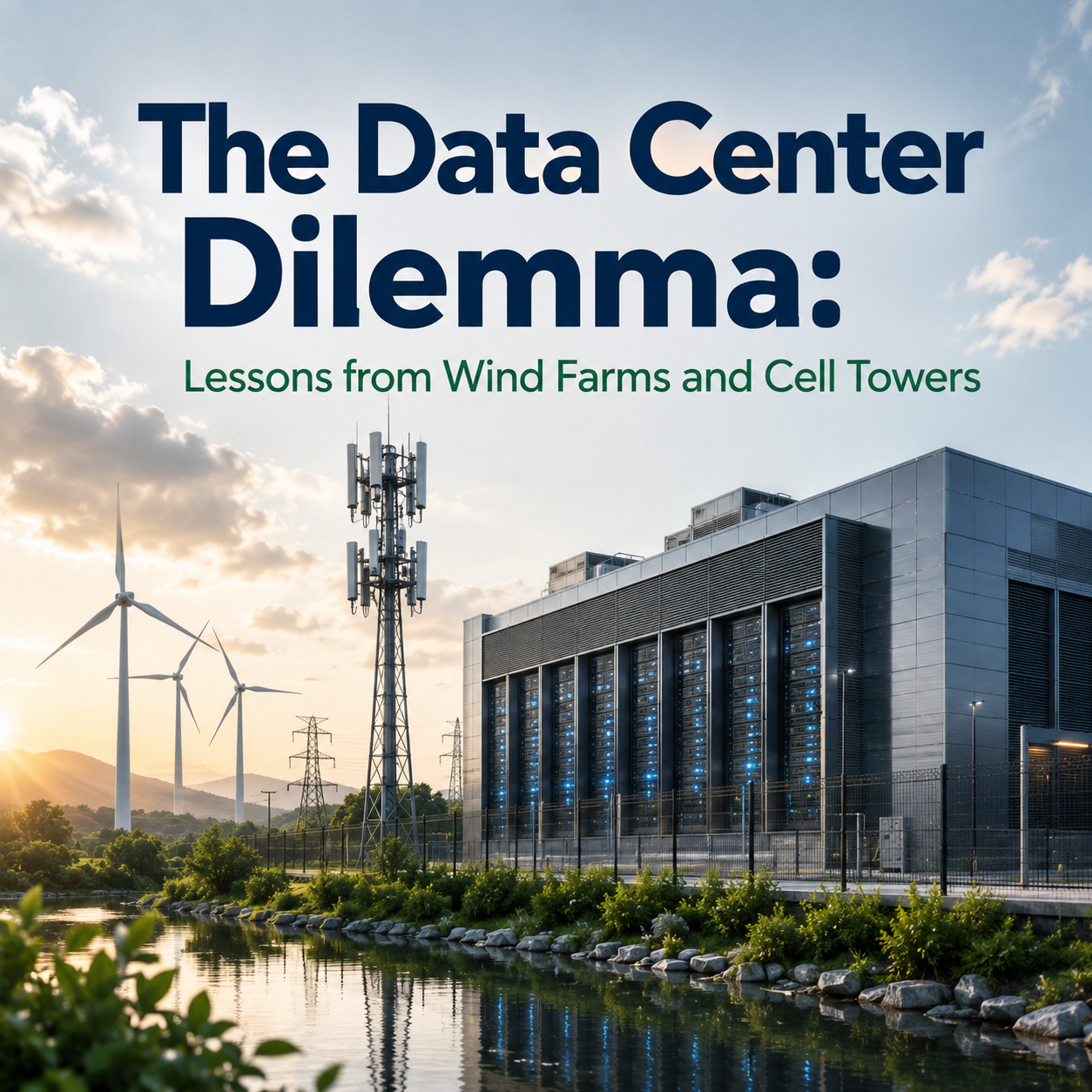
Data centers are often described as invisible infrastructure because the public uses them every day without seeing them. Every online search, credit card transaction, training platform, AI tool, cloud database, or streaming service depends on servers housed somewhere.
However, to local communities, data centers are anything but invisible. They can bring large industrial buildings, backup generators, new power infrastructure, increased water consumption, construction traffic, and ongoing operational noise.
As artificial intelligence and cloud computing continue to grow, communities are asking an increasingly important question:
Who benefits, and who bears the impact?
The Five Major Concerns Communities Raise
Electricity Demand
Modern data centers require enormous amounts of power. Residents often worry that utility upgrades may ultimately increase costs for ratepayers or place additional strain on local grids.
Water Use
Many facilities rely on water-intensive cooling systems. In drought-prone or water-stressed regions, concerns about long-term water availability can quickly become a source of public opposition.
Noise and Quality of Life
Cooling equipment and backup generators may create continuous background noise. While construction disruption is temporary, operational noise can become a long-term concern for nearby residents.
Tax Incentives
Governments frequently offer incentives to attract data center investment. Communities often question whether the economic benefits justify the public subsidies, particularly when permanent job creation is relatively limited.
Lack of Trust
Opposition often intensifies when residents feel key decisions were made before meaningful public consultation occurred.
A 2026 Gallup poll found that seven in ten Americans opposed the construction of an AI data center in their local community, highlighting how rapidly data centers have become a public policy issue.
What Wind Farms Can Teach Data Center Developers
Wind energy projects faced many of the same challenges now confronting data centers.
Nationally, wind power was promoted as clean, renewable, and essential. Locally, residents saw turbines, transmission lines, altered landscapes, and changes to rural communities.
The Fairness Challenge
One of the biggest lessons from wind development was that benefits and impacts are not always distributed equally.
A landowner hosting turbines may receive lease payments, while neighboring property owners experience visual impacts without receiving compensation.
This created a recurring question:
Are the benefits being shared fairly?
The Importance of Early Engagement
Research consistently showed that community support improved when:
- Residents were involved early
- Benefits were clearly communicated
- Local concerns were addressed transparensively
- Communities received measurable value
The same principle applies directly to data centers.
Simply stating that a project supports technology growth is rarely enough. Communities want to understand how the project benefits them specifically.
What Cell Phone Towers Can Teach Data Center Developers
Cell phone towers created a different version of the same conflict.
Almost everyone wanted stronger wireless service.
Far fewer people wanted a tower near their home.
The Infrastructure Paradox
The debate was rarely about mobile phones themselves.
Instead, disputes centered on:
- Visual impacts
- Property values
- Zoning authority
- Neighborhood character
- Fair distribution of benefits
This created a tension that remains relevant today:
National infrastructure needs versus local community control.
Local Control vs. Public Need
Telecommunications companies argued that reliable wireless coverage required faster infrastructure deployment.
Local governments argued that communities should retain authority over land use decisions.
Today, data centers face the same debate.
Governments may view them as critical infrastructure for AI, cloud computing, defense, and economic development.
Residents may view them as resource-intensive industrial facilities that permanently change their community.
The Shared Pattern: We Want the Service, Not the Structure
Across multiple industries, the same pattern emerges.
Wind Farms
- Public wants: Clean energy
- Communities often resist: Turbines, visual impacts, transmission lines, and land disruption
Cell Phone Towers
- Public wants: Reliable wireless service
- Communities often resist: Towers near homes, schools, scenic areas, and concerns about neighborhood character
Data Centers
- Public wants: AI services, cloud computing, streaming platforms, and a strong digital economy
- Communities often resist: High power consumption, water use, noise, tax incentives, and land-use impacts
This is not a contradiction.
People can support a service while objecting to how the supporting infrastructure is planned, located, or managed. Communities are often less concerned about the technology itself and more concerned about whether costs, benefits, and impacts are distributed fairly.
The "Other People's Land" Problem
Many infrastructure disputes stem from uneven distribution of benefits.
With cell towers, one property owner receives lease payments while neighboring residents experience the visual impact.
With wind farms, some landowners receive turbine revenue while others do not.
Data centers may create an even broader version of this issue.
Communities often ask:
- Who pays for grid upgrades?
- Who protects local water supplies?
- Who monitors noise levels?
- Who benefits economically?
- Who guarantees local jobs?
- Who is accountable if promised benefits do not materialize?
When these questions remain unanswered, opposition becomes more likely.
Economic Promise vs. Local Reality
Developers frequently promote infrastructure projects based on:
- Job creation
- Tax revenue
- Economic growth
- Community investment
However, residents increasingly want evidence rather than promises.
Communities are becoming more sophisticated in evaluating proposed projects.
They want:
- Measurable commitments
- Transparent projections
- Independent analysis
- Enforceable agreements
Rather than broad claims about future benefits.
Four Lessons Data Center Developers Should Learn
1. Transparency Must Come First
Public engagement should occur before major agreements are finalized, not after.
2. Community Benefits Must Be Real
If incentives are provided, communities should clearly understand what they receive in return.
Potential benefits may include:
- Local hiring commitments
- Infrastructure improvements
- Utility protections
- Water conservation programs
- Emergency response funding
- Community benefit agreements
3. Location Matters
A facility located within an established industrial area creates different impacts than one located near homes, schools, farmland, or environmentally sensitive areas.
4. Technical Assurances Are Not Enough
Developers often focus on engineering and compliance.
Communities focus on trust, fairness, and quality of life.
Successful projects address both.
A Better Path Forward
Data centers are becoming essential infrastructure for the modern economy.
The question is no longer whether society needs them.
The question is how they should be planned, approved, and managed.
A responsible approval process should include:
- Clear disclosure of projected electricity use
- Clear disclosure of projected water use
- Utility impact assessments
- Public review before final agreements
- Noise and generator standards
- Water conservation commitments
- Local tax benefit analysis
- Community benefit agreements
- Enforceable operating conditions
Conclusion
Data centers represent the newest chapter in a familiar infrastructure story.
Wind farms showed that even projects with broad public support can face opposition when communities believe impacts are unfairly distributed.
Cell towers demonstrated that people may value a service while resisting the infrastructure required to deliver it.
Data centers now combine elements of both debates. They support the digital economy, but they also require significant land, power, water, and community trust.
The solution is not to dismiss local concerns as anti-technology.
The solution is transparency, fairness, accountability, and meaningful public engagement.
Ultimately, communities are asking the same question they asked about wind farms and cell towers:
Are the benefits and burdens being shared honestly?