Fair Infrastructure Development
A Fairer Path Forward for Data Centers
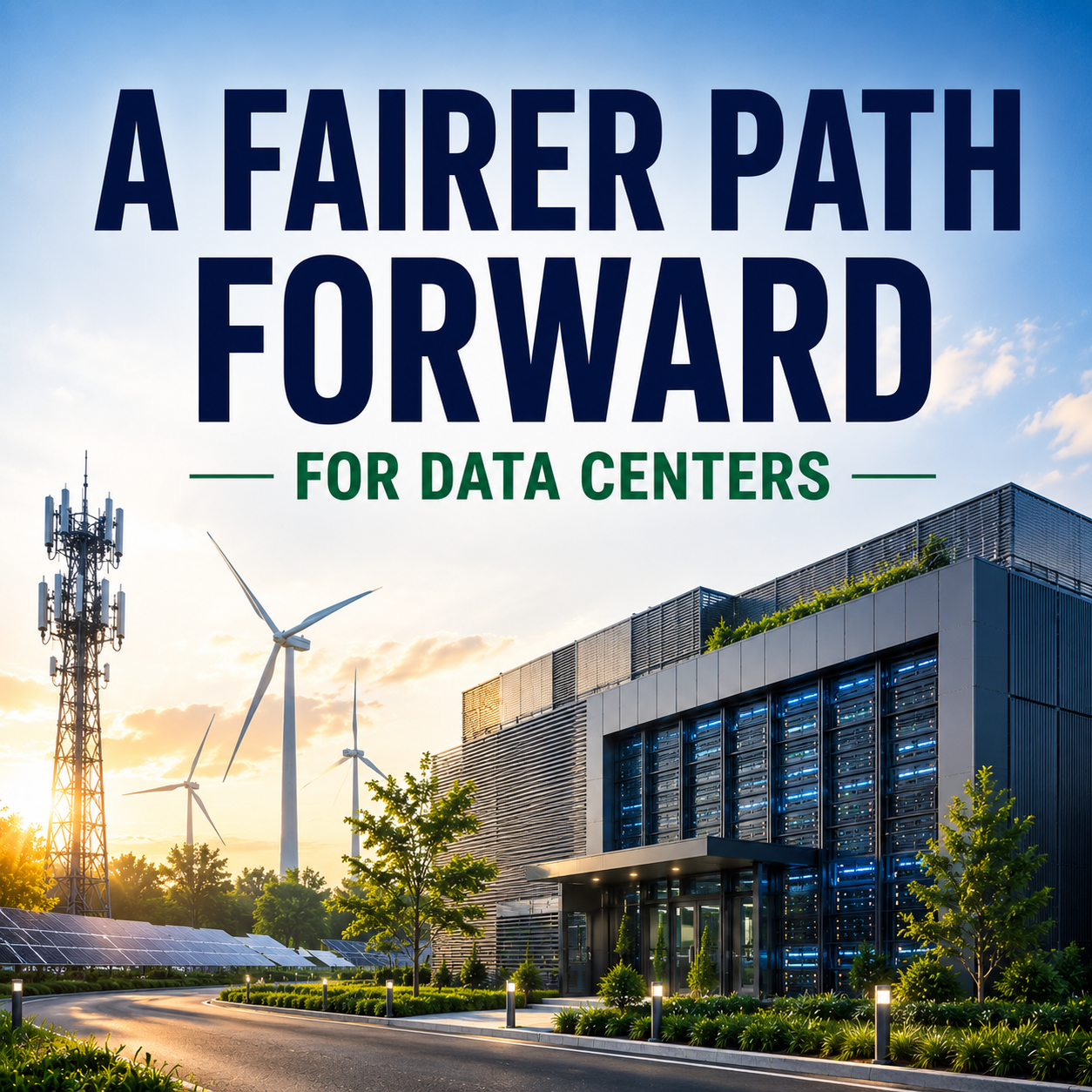
Data centers are likely to become essential infrastructure. Artificial intelligence, cloud computing, cybersecurity, digital records, online training, logistics, banking, health care, and government services all depend on them.
The question is not whether society needs data centers.
The better question is how they should be built, approved, powered, cooled, taxed, and monitored.
The conflicts around wind farms and cell phone towers offer a clear warning: if communities feel ignored, opposition grows. If benefits are vague and burdens are local, trust disappears.
Data center developers and public officials should learn from that history.
Start With Transparency
The first step is honest disclosure.
Communities should know:
- how much electricity the data center is expected to use;
- whether the power grid needs upgrades;
- whether ratepayers could be affected.
They should know:
- how much water will be used;
- what cooling system will be installed;
- whether recycled water, closed-loop systems, or other conservation methods are available.
They should know:
- whether backup generators will be used;
- what fuel they will require;
- how often they may run;
- what air-quality standards apply.
They should also know:
- what tax incentives are being offered;
- what the community receives in exchange.
Transparency does not guarantee approval, but secrecy almost guarantees opposition.
Treat Data Centers Like Major Infrastructure
Data centers should not be treated as ordinary warehouses.
They may look like large industrial buildings, but their impact can be much greater because of power demand, cooling needs, security requirements, and backup systems.
A responsible approval process should include:
- utility impact analysis;
- water impact analysis;
- noise studies;
- air-quality review;
- emergency response planning;
- traffic and construction planning;
- tax incentive review;
- community benefit evaluation.
If a project is large enough to affect local resources, it is large enough to require serious public review.
Create Real Community Benefits
Communities are more likely to accept infrastructure when they receive measurable value.
For data centers, community benefits could include:
- funding for utility upgrades that protects residents from cost increases;
- local hiring and workforce training commitments;
- support for community colleges or technical education;
- investment in renewable energy or grid resilience;
- water conservation projects;
- road improvements;
- emergency services funding;
- annual public reporting on resource use.
The benefit should not be vague. It should be written, measurable, and enforceable.
Choose Better Locations
Location is one of the most important decisions.
A data center may be more appropriate in an industrial zone with strong existing power infrastructure than near homes, schools, farms, wetlands, or water-stressed areas.
Good siting can reduce conflict before it begins.
Wind farms faced opposition when they were placed where residents felt the landscape was being sacrificed. Cell towers faced opposition when they were placed too close to homes or in visually sensitive areas.
Data centers will face the same issue if location decisions appear driven only by land cost, tax incentives, or utility access without considering community impact.
Build Trust Before Approval
Public engagement should happen before major decisions are final.
Too often, communities are invited to comment only after developers, landowners, utilities, and public officials have already shaped the project. At that point, public meetings feel symbolic rather than meaningful.
A better approach would include:
- early listening sessions;
- public summaries;
- independent technical review;
- clear answers to community questions.
Developers should explain not only why the project is needed, but why the selected location is appropriate.
Learn From Wind Farms and Cell Towers
Wind farms taught that good intentions do not erase local concerns. Clean energy still required fair siting, community engagement, and benefit-sharing.
Cell phone towers taught that people may want the service while objecting to the structure. Better communication service did not automatically overcome concerns about land use, appearance, and proximity.
Data centers now face both lessons at once.
People want:
- digital tools;
- artificial intelligence;
- cloud systems;
- online services.
But communities also want protection from:
- unfair costs;
- resource strain;
- noise;
- poorly planned development.
Conclusion: Fairness Is the Future of Data Center Approval
Data centers are part of the future, but they cannot be built responsibly by ignoring the past.
The history of wind farms and cell phone towers shows that infrastructure approval depends on more than technical need. It depends on trust, transparency, location, enforceable protections, and fair distribution of benefits.
Communities are not simply asking, “Do we need data centers?”
They are asking:
- Why here?
- Who benefits?
- Who pays?
- Who protects us?
- What guarantees are in writing?
- What happens if the promises are not kept?
Those are fair questions.
If data center developers and public officials answer them honestly, data centers can move forward with less conflict. If they do not, data centers may become the next major infrastructure fight across the country.