California Minimum Wage Requirements
New Minimum Wage Laws - Take Effect July 1, 2026
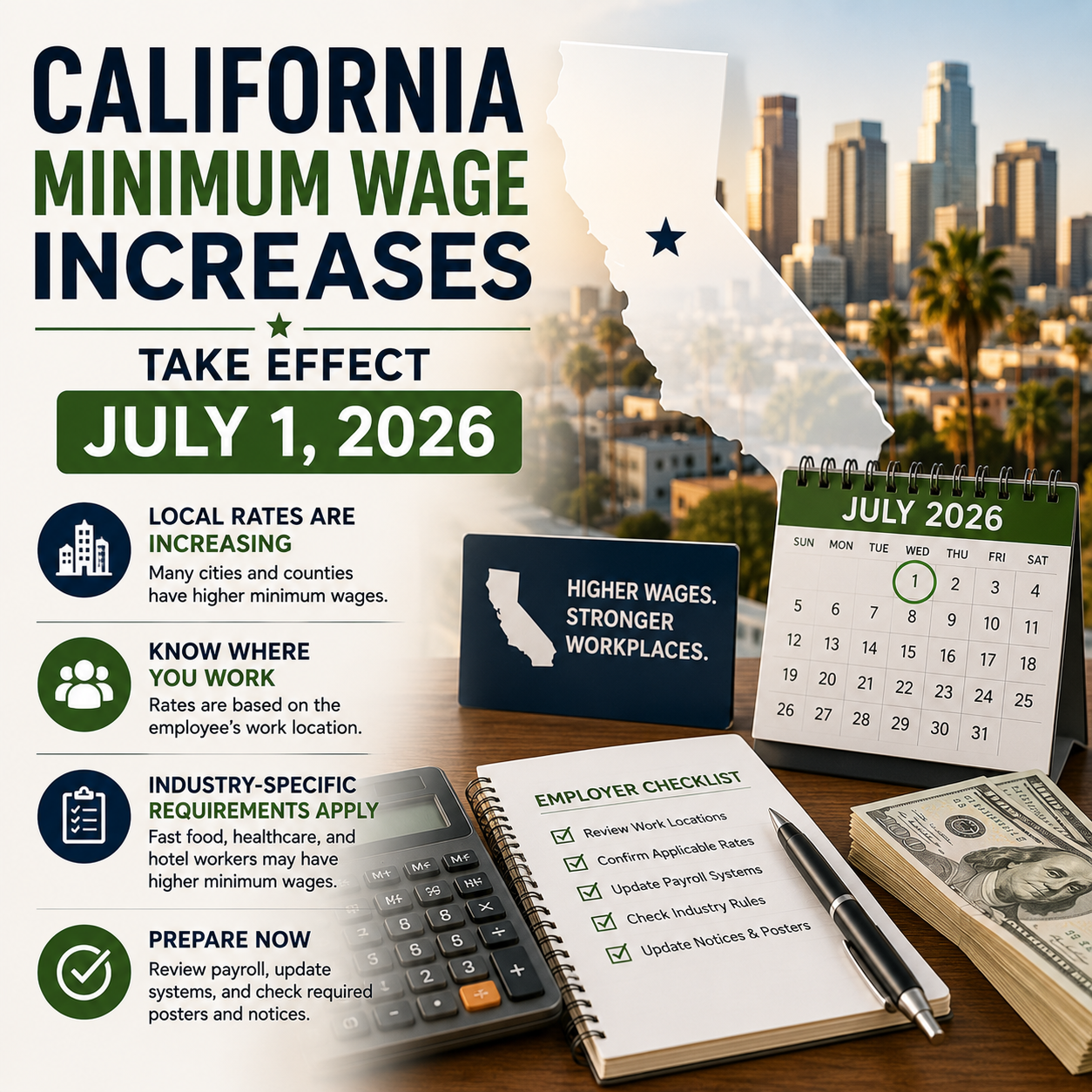
California Minimum Wage Increases Take Effect July 1, 2026
Employers throughout California should review their employee pay rates before July 1, 2026. Although California has a statewide minimum wage, many cities and counties require employers to pay higher local rates.
The applicable minimum wage is generally based on where the employee physically performs the work—not where the employer’s main office is located.
Local Minimum Wage Rates Effective July 1, 2026
The following California jurisdictions will have updated minimum wage rates beginning July 1:
- City of Los Angeles: $18.42 per hour
- Unincorporated Los Angeles County: $18.47 per hour
- Santa Monica: $18.47 per hour
- Pasadena: $18.57 per hour
- Malibu: $17.91 per hour
- Milpitas: $18.50 per hour
- Emeryville: $20.34 per hour
- Berkeley: $19.61 per hour
- San Francisco: $19.61 per hour
- Fremont: $18.05 per hour
- West Hollywood: $20.25 per hour
Employers should confirm the current requirements with the city or county in which each employee works, as local rates and rules may change.
California’s Statewide Minimum Wage
Effective January 1, 2026, California’s statewide minimum wage is $16.90 per hour for all employers, regardless of business size.
When a city or county establishes a higher minimum wage, employers must generally pay the higher local rate.
Industry-Specific Minimum Wages
Certain California workers may be covered by industry-specific minimum wage requirements that are higher than state or local rates.
Examples include:
- Fast-food workers: Employees of covered fast-food restaurant chains with at least 60 locations nationwide may be entitled to a minimum wage of $20.00 per hour.
- Healthcare workers: Rates vary based on the type of healthcare facility. Some large hospitals and dialysis clinics may be required to pay as much as $25.00 per hour, while certain smaller clinics and skilled nursing facilities may have a $23.00-per-hour requirement.
- Hotel and hospitality workers: Some cities have established higher minimum wages for hotel employees. Examples include $25.00 per hour for certain hotel workers in Los Angeles and Glendale and $26.50 per hour for covered hotel workers in Long Beach.
Employers in these industries should carefully review the eligibility requirements, effective dates, and exceptions that apply to their specific operations.
Which Minimum Wage Applies?
Employers must pay employees based on the jurisdiction where the work is physically performed. This requirement may also apply to remote employees and employees who work at multiple locations.
For employees who perform work in more than one jurisdiction during the same workweek, employers should track where the work was performed and pay the applicable minimum wage for the hours worked in each jurisdiction.
Many cities and counties provide online jurisdiction maps and minimum wage resources. The City of Los Angeles, for example, offers tools to help employers determine whether a work location falls within city limits. The UC Berkeley Labor Center also maintains a statewide tracker of local minimum wage ordinances.
What Employers Should Do Before July 1
Employers should take the following steps before the new rates take effect:
- Review the work location of every California employee.
- Confirm the applicable state, local, and industry-specific minimum wage.
- Contact the company’s payroll provider regarding required rate changes.
- Update payroll systems before the first affected payroll period.
- Review wage notices, offer letters, and compensation plans tied to minimum wage.
- Replace or update required workplace posters.
- Confirm that remote and multi-location employees are paid correctly.
Paying less than the applicable minimum wage—even unintentionally—can expose an employer to wage claims, back-pay liability, penalties, interest, and attorneys’ fees.
Employer Pro Tip
Do not assume that California’s statewide minimum wage is the correct rate for every employee. Local ordinances frequently require higher wages, and hotel, fast-food, and healthcare employees may be subject to additional requirements.
California employment compliance also extends beyond wages. Outdated employee handbooks, missing workplace posters, incomplete wage notices, and gaps in company policies can all increase the risk of costly employee claims.
Employers should review their payroll and HR compliance practices now to ensure all required updates are in place before July 1, 2026.