Property Value Guide
The Difference Between Market Value and Asking Price
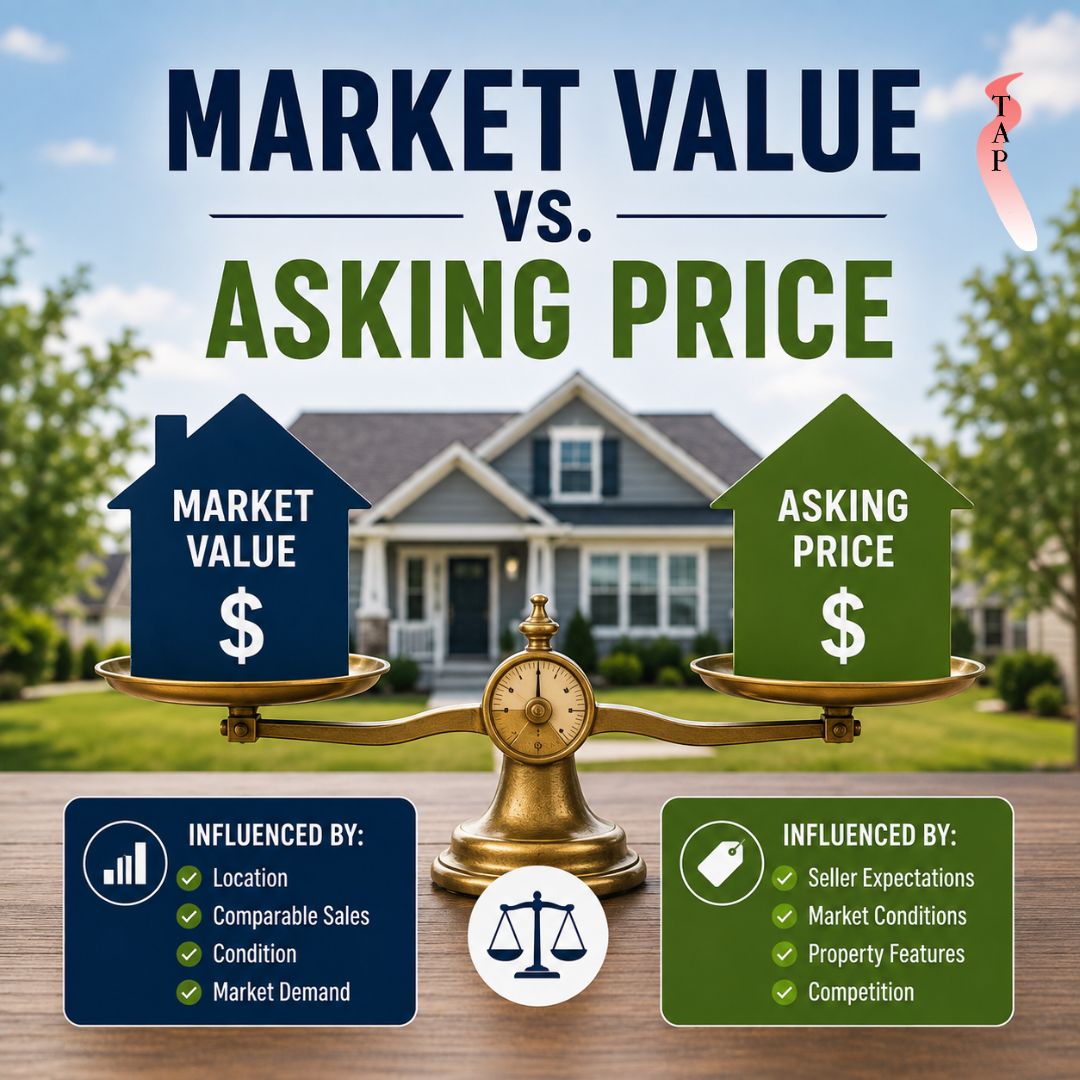
When searching for a home, buyers often assume that a property's asking price reflects its actual value. In reality, the asking price and market value are not always the same. A property may be listed above, below, or close to its estimated market value depending on a variety of factors.
Understanding the difference between these two concepts can help buyers evaluate properties more objectively and make informed decisions throughout the home-buying process. Rather than focusing only on the listing price, it is helpful to understand what influences a property's value and why prices may differ.
What Is an Asking Price?
The asking price is the amount a property is listed for when it is offered for sale.
It represents the seller's desired selling price at the time the property enters the market.
An asking price may be influenced by factors such as:
- Current market conditions
- The property's features
- Recent improvements
- Local competition
- Seller expectations
Because it is a listing price, it does not necessarily represent the property's estimated market value.
What Is Market Value?
Market value is an estimate of what a property may reasonably be worth based on current market conditions.
It is generally influenced by factors such as:
- Comparable recent property sales
- Location
- Property size
- Condition
- Features and upgrades
- Local housing demand
- Economic conditions
Unlike the asking price, market value attempts to reflect what buyers may reasonably be willing to pay under normal market conditions.
Why the Two May Be Different
There are several reasons why a property's asking price may differ from its estimated market value.
For example:
- A seller may list the property higher in hopes of attracting stronger offers.
- A competitive market may encourage lower listing prices to generate greater buyer interest.
- Unique property features may influence pricing.
- Market conditions may change after the property is listed.
These differences are common and do not necessarily indicate that a property is overpriced or underpriced.
Factors That Influence Market Value
A property's estimated market value is shaped by many different factors.
Some of the most important include:
Location
Location remains one of the strongest influences on property value.
Factors include:
- School access
- Transportation
- Employment opportunities
- Shopping and amenities
- Neighborhood appeal
Property Size
Larger homes or lots may have higher market values than similar properties with less living space or smaller land areas.
Property Condition
Well-maintained homes often compare differently with properties requiring repairs or significant updates.
Features such as:
- Modern kitchens
- Updated bathrooms
- New roofing
- Energy-efficient improvements
may influence perceived value.
Comparable Sales
Recently sold properties with similar characteristics help establish reasonable pricing expectations.
Comparable sales often consider:
- Home size
- Age
- Condition
- Neighborhood
- Features
These comparisons provide useful context when evaluating market value.
Supply and Demand
Housing supply and buyer demand also influence market value.
For example:
- Limited inventory combined with strong buyer demand may place upward pressure on values.
- Greater housing availability may create more competition among sellers.
Market conditions continue to change over time.
Practical Example
Imagine two nearly identical homes in the same neighborhood.
Property A is listed for $450,000.
Property B recently sold for $430,000.
After reviewing other recent sales and current market conditions, buyers may determine that the estimated market value of Property A is closer to the lower figure than the asking price.
On the other hand, if several comparable homes have recently sold near the asking price, the listing may better reflect current market value.
This example demonstrates why buyers should look beyond the asking price alone.
Why Buyers Should Research Before Purchasing
Rather than relying only on a property's listing price, buyers may benefit from researching:
- Comparable home sales
- Neighborhood trends
- Property condition
- Local amenities
- Future community development
Considering these factors together provides a more complete understanding of the property's overall value.
Avoid Making Decisions Based Only on Price
A lower asking price does not automatically mean a better value.
Likewise, a higher asking price does not necessarily indicate a property is overpriced.
Instead, buyers should evaluate:
- Overall condition
- Location
- Long-term ownership costs
- Maintenance needs
- Features that match their lifestyle
Looking at the complete picture often leads to more informed purchasing decisions.
Questions to Ask Yourself
As you compare properties, consider asking:
- How does this price compare with similar homes nearby?
- What features contribute to the property's value?
- Does the location support my long-term needs?
- What ongoing ownership costs should I expect?
- Am I evaluating the home based on facts rather than assumptions?
These questions encourage a balanced and objective approach.
Conclusion
Understanding the difference between market value and asking price is an important part of becoming a more informed homebuyer. While the asking price reflects the amount a seller hopes to receive, market value is influenced by factors such as location, property condition, comparable sales, and current market conditions.
By looking beyond the listing price and researching the factors that contribute to property value, buyers can better evaluate homes and make purchasing decisions based on a broader understanding of the real estate market.